I want to paint this. Where do I start?HIDI GUIDE 3 - Line & Wash 1
- Mark East
- Jun 4
- 11 min read

Updated: Jun 19


This isn't merely a reiteration of theory; it's a guide to my approach. I call them
"How I Did It Guides" or HIDI for short. In this third guide I reference artists whose work has influenced me and my art because they possess a unique quality. It's the quality every artist aspires to have. People admire their work, but why? What is it about their art that touches your soul?
I've started writing this article three times, and each time the context changed. It was one of those life moments when you pause and reassess what you are about to publish and question yourself.
Why am I doing this? Why am I even writing this article? I'm writing it because during its inception it has transformed my approach to my art and what I aim to achieve in my ongoing journey with it.
5 years ago having fully retired I started to read and research. Pursuing my fascination with the whole subject of art, one of the first books I bought was written by an artist called Adrian Hill (1895- 1977). I subsequently bought all of his publications. He was one of the pioneering TV artists in the UK and a person I have previously covered.
Hill released his first book "What Shall We Draw," in 1957. "Further Steps in Drawing and Sketching", the second book I bought he released in 1972. I still refer back to it for guidance to this day. In its introduction, he mentioned an art book that had shaped his drawing style, "The Illustrated London Drawing Book." This book was authored by Robert Scott Burn and published in 1853, which is 173 years ago!
Hill was a British artist, writer, educator, and broadcaster. He served with the Honourable Artillery Company during World War I and was the first artist commissioned by the Imperial War Museum to record the conflict on the Western Front. He wrote many books about painting and drawing, and in the 1950s and early 1960s presented a BBC children’s television program called Sketch Club.
Why do I tell you this? Because he was one of the first and I still believe, one of the best sketchers I came across, as I explored texts and tutorials to improve my knowledge and artistic skills.
I still have many of his books. Although written in the '50s and '60s, his simplistic approach really appealed to me.
Back to the question. I want to paint this where do I start?
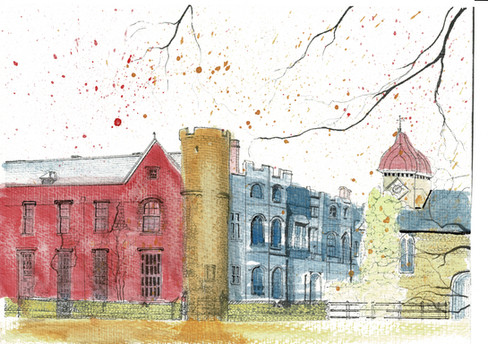
Croft Castle's original structure was built around 1085, but the current building primarily dates back to the 1660s, replacing an earlier house on the site. It's a fantastic location for painting and worth visiting if you're living in or vacationing in the UK. Honestly, I didn't visit Croft with the intention of writing an article.
This idea came about four years later, inspired by some of the images in this article and many sketches. So don't consider this as a guide because "guide" might give the wrong impression - it's more of a statement on how not to do it... Hence the title "I want to paint this where do I start?"
That's why I stopped midway through writing the first few iterations of this article and questioned myself, what am I doing? Who am I, an untrained artist, to instruct aspiring artists on how to proceed?
So, now we have reached the point from where I can really start this article.
Why do I think I can tell you how to do it?
Well, I can't. It would be presumptuous and extremely pompous because there are much better artists out there. I'm ok but Im not going to fool myself that I can teach you how to become an award winning artist, a master even. What I hope to do is share the processes I go through to create a watercolour, an acrylic, a charcoal or a pastel and hope that by documenting them you can improve and learn.The rest as they say is up to you.
Unconscious Competence
Like all exceptional artists, Adrian Hill's books addressed the significance of composition, perspective, and especially the goals of object drawing. For me, when I start to create a Line and Wash those goals are critical. Get the drawing wrong and the rest is a waste of time.
The topics below and a few more are featured in the newest "How I Did It Guide," or HIDI Guide for short.
Are you aware of your own limitations?
Do you seek confirmation that your work is of quality?
Will my work achieve the vision I have for it?
We all arrive at a moment when we ponder the profound question below.
Am I good enough?
Perhaps we should approach that question differently. Am I good enough for what I want to achieve?
Who determines whether the way you create art is right or wrong? It's not as if you're holding people's lives in your hands. What you create should be enough to satisfy you and evoke a response from those who view it. Our initial reaction to art is subliminal, ingrained in our ancestral DNA. Colours, eyes, faces, and shapes act as triggers to our almost unconscious responses to danger and emotion, which have brought us to where we are today. This article and the "How I Did It Guides" are written in response to that self reflection, aiming to share the challenges, doubts, and questions I encountered along the way with anyone who is interested.
The challenge, when applying competence to art, is that it leads us to evaluate and measure what is considered good or bad, creating standards for assessment. We establish methods, write teaching guides, and assert that art must include specific elements to be successful. These rules and guidelines can hinder our creativity, if we let them. That's why I must admit I find the term "Critique" challenging. I do use it, but when you consider its definition as a detailed, systematic evaluation or analysis of a work, it raises questions about where emotion fits in and what standard the systematic evaluation is being compared to.
Art is subjective, and the first decision you need to make is why you're pursuing it. If your goal is to make it a career, you'll have to engage with the system and develop competence as recognized by the art market. In other words, you'll need to show competence. If you are doing it for relaxation and enjoyment then who cares what others think? Well I think if we are honest we all like people to appreciate our efforts and as a result we need to understand what creates emotion and response.
HIDI Guide 3 also covers another term "Armature" and specifically a Cruciform.
What's a cruciform armature, you ask? Let's, for simplicity, call it a framework. Having never been to art school or attended an art lesson in my life, when I retired, I just started to paint as a hobby. Somehow my art was appreciated and people started to ask me to undertake commissions for them. So very quickly my hobby became more interesting. Why do they like it? I started to research and google. That's how I found Adrian Hill and soon after Ian Roberts both artists whose work resonated with me. Reading Ian's book on "Mastering Composition" I came across Armatures and his explanation of the function they play in composition. The way to make your art resonate or, as I have eluded to, get an emotional response from others.
Becoming an unconscious competent in the world of art.
I have included one of Ian's paintings for you to explore and expand the concept of a cruciform armature, one of the many armatures covered in his book.

Why include the painting? Leonardo da Vinci made the point that
"The more you describe, the more you confuse. It is necessary to draw as well as describe."
In this world of limited attention span his words seem more relevant now than ever.
What are we trying to achieve as artists?
Could it be mastery of our art?
Could it be Unconscious Competence?
Could it be Satisfaction, Recognition, Income or Something Else?
Deciding that will determine where you go next with your art and how competent you want to become.
The full four-stage competence model when learning a skill is attributed to Martin Broadwell who in 1969 wrote an article about Teaching for Learning: If you want to learn more I explore it in more depth in the forthcoming guide but for now its suffice to say that as artists most of us start as Unconscious Incompetents and if we are lucky graduate to "Conscious Competents". A real master of their art could be said to be an "Unconscious Competent". (They do it without thinking about it, it comes naturally.)
What is Line and Wash?
Numerous artists write extensive texts on this topic. For those who have never created a line and wash, it might be mistaken for merely "colouring in." However, this view overlooks the significance of the composition's framework. It still requires skill, and this skill intersects with some fundamental artistic elements. This is the approach and medium I eventually decided upon and what HIDI 3 is all about.
My attempt to create a really good Compositional Drawing and why
A framework to hang the work upon.
Watercolour Wash Techniques
Final Detailing
The Line Drawing.
Adrian Hill's exceptional artistry stemmed from his skill in sketching, allowing him to swiftly capture dramatic scenes during and after World War I battles. His work was grounded in strong drawing techniques and principles. Considering his task of documenting the outcomes of war it is clear that these were not emotional artworks but factual drawings that documented both the effects and the destruction caused. Yet when studying his works and sketches the emotion is all there for us to see.

The Line Drawing Exercise (Extracts from the Guide)
Within Art-Club Free we set tasks every week or so, which cover some of the artistic basics which are needed, as a minimum for emotional success. Recently group members were given an exercise to create a preparatory drawing based on the original photo at the top of the page. It was that exercise and the results from it that acted as a catalyst to "How I Did It Guide 3".
Using the photograph as a reference, I assigned the group the task of creating their own sketches toward the creation of a line and wash artwork. To assist them, I provided two examples of sketches I had made.
The main objective was to demonstrate how I utilize sketches to formalize my concepts and produce a drawing/sketch that helps me in crafting an acceptable piece of work.
(This process is referred to in artistic terms as developing perspective and composition)
The choices available were to either evaluate the two sketches and select one for creating a coloured line and wash, justifying their selection, or to develop their own sketch based on the photo as the next step in establishing the Line element.
Composition and Perspective



Sketch 1 - Original Sketch From Photo Sketch 2 - Compositional Sketch
Composition
Put simply, composition is the way that the artist composes elements to make them make sense to the eye. It's not what you see close up when you are admiring the artist’s brush skills or detail. It's what you see from a distance, the elements I have listed below that draw you to the picture in the first instance. It’s the subliminal response we talked about earlier that we are striving for.
If you are a beginner you need some early successes. So if there is one piece of advice I would give it's simplify your early works as much as possible and concentrate on the key elements below. It's that first step of learning your limits that make you a better artist.
The elements that can influence the artwork and its composition can be :-
Blocks of colour (understand warm and cool colours and how they influence depth)
Light and dark shades (Tones)
Space
Texture
Focal points
Figures
Lines & Shapes
The way in which these are organised across the artwork, the composition, could therefore be classified as "the armature", in other words the structure of the painting. The word armature originated in the creation of moulded sculptures sometimes with clay or other mouldable materials. The armature is in fact the framework on which the mouldable material is formed around. When applying the term to a painting it also becomes the content which holds the composition together.
Good composition leads the eye where the artist wants the viewer to go. Bad composition does just the opposite that's all you really need to concentrate upon when creating the journey through your work.
Sketching
Why bother with a sketch at all?
Adrian Hill wrote "If you want to know how something is made or how it ends up as a certain shape, in short how it comes about, then sit down and draw it" That statement didn't really resonate with me until I was asked by a golfing friend to produce a painting for his wife's birthday.

All he could give me as a reference to the setting of the painting was a postcard of Sheerwater, Port Navas.
Why do I tell you this?
After sketching and then painting the watercolor, I completely forgot about it.
That was until several years later while watching TV.
The program featured a holiday cottage destination that seemed oddly familiar.
I mentioned to my wife, "I somehow recognize that place, but I don't know why." I had never visited it, and still haven't, but having sketched and painted it, I now realise that it had lodged in my subconscious. It felt like an old friend you see on the street, someone you know but whose name you can't recall. Adrian Hill's words came rushing back to me. I suddenly realized why—because I had drawn it in detail and, in doing so, had committed it to memory.
You would be surprised by how much you learn while sketching, following directions, considering tone, and identifying the horizon line and focal points. Additionally, it greatly contributes to developing ideas for your next creation.
You can do two things with a sketch.
Make it an artwork in its own right
Make it a working drawing, the precursor to a final creation.
In both cases you need to put time into both because, whether you reject it later, you will learn so much in the process and unconsciously you will develop and refine your ideas.
I have a precise example of that for you. While I was preparing the working drawing for the HIDI guide, my wife, who is planning to decorate our library (it's not as grand as it sounds, believe me), expressed her vision for the decor. She said, "I want it to be entirely minimal." As a result, I'm searching for a minimal painting. Could I have that sketch you're working on? It would be ideal. Don't put a wash on it just leave it as it is !!! I couldnt resist a little bit of artistic colour but here it is ready for framing and hanging.

Light & Dark
Some artists talk about using thumbnail sketches to highlight light and dark and aid composition creation. I use them to highlight and simplify a complex picture but, my more usual approach is to produce several quite detailed sketches, sometimes in colour, rather than just shaded thumbnails. Below are the first two sketches, subsequently rejected but very useful as works for comment in Art-Club Free.
The sketch below was produced on Arches A3, larger than I would normally use for development sketches but I wanted to demonstrate in detail some of the elements described above.


In the HIDI I talk about how I positioned the horizon and vanishing points and made sure that the composition encouraged the viewer to travel around the artwork yet maintaining the central point of interest the central tower. I also include several more versions of the same sketch with different treatments one in charcoal and two more with different wash treatments.
The HIDI Guide also offers advice on materials, line marking pens, creating and layering washes, lifting out, shading, and developing technique.
Why did I choose Arches Watercolour paper? Since the artwork was made for discussion, I wanted to incorporate some basic watercolor techniques like using a dry brush to create sparkle and the process of lifting out to remove parts of a watercolor wash. Notice the sunlight filtering through the trees onto the lawn in the very near foreground, as well as the lifted out elements on the green wash of the large tree.

Some more examples of different approaches to the same sketch with explanations are also included from the How I Did It Guide




Comments